Announcing that the great day of the lord is nearer than you think. O Come let us adore him - Luke 2:13
יוֹם הַתְּרוּעָה
Yom Haturah
Ring H
8-13
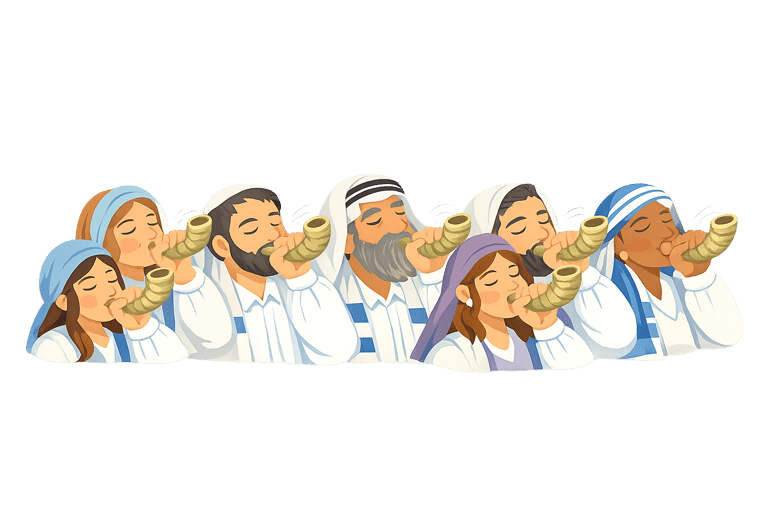
Yom HaTeruah is the only moed where no narrative, no event, no historical anchor is given. Only this: זִכְרוֹן תְּרוּעָה - a memorial of a teruah‑sound. A day where sound itself is the command.
For many, this day is only known by the borrowed name “Rosh Hashanah,” a title Scripture never gives it. This misnomer is the direct result of the rabbinical authorities shifting God’s calendar forward by six months, moving the head of the year from the first month of redemption to the seventh month of rest. And when you move the anchor, you blur the names. You bury the moedim beneath titles they never carried. Yom HaTeruah becomes “New Year,” the shofar‑day becomes a civil holiday, and the true voice of the feast, the teruah itself, is obscured. Ezekiel tells us his vision came “בְּרֹאשׁ הַשָּׁנָה - at the head of the year,” on the tenth day of the month. If this were the seventh month, he would be speaking on Yom HaKippurim, the most solemn day of the calendar, a day no prophet would rename or obscure. But Ezekiel is not standing in Tishrei. He is standing in the first month, the month God Himself called the beginning of months. The tenth of that month is the day the lamb is chosen, the day the house inspects its Passover. Ezekiel’s ‘Rosh HaShanah’ is not a new feast; it is the calendar God gave to Moshe, the year that begins in Nisan. The only time Scripture uses the phrase ‘head of the year,’ it anchors the year to redemption, not to the rabbinic shift that moved the calendar forward six months and buried the moedim beneath names they never bore. How does God see it when the calendar He carved into Israel’s bones is shifted, renamed, and rebuilt by human hands? He sees His revelation bent. He sees His appointed times blurred. He sees the rhythm He spoke at Sinai, the very cadence of redemption, traded for a system that rises not from His voice but from the councils of men. And Ezekiel stands as His witness. The prophet tells us his vision came “בְּרֹאשׁ הַשָּׁנָה - at the head of the year,” on the tenth day of the month. If this were the seventh month, he would be speaking on Yom HaKippurim, the most solemn day of the calendar, a day no prophet would dare rename or obscure. But Ezekiel is not standing in Tishrei. He is standing in the first month, the month God Himself called the beginning of months. The tenth of that month is the day the lamb is chosen, the day the house inspects its Passover. Ezekiel’s ‘Rosh HaShanah’ is not a new feast; it is the original calendar God gave to Moshe, the year that begins in Nisan. And this matters, because the shift did not happen in Babylon, nor under Ezra, nor anywhere in the Second Temple era. The year was moved only in the rabbinic period, after the Temple fell, after the priesthood was scattered, when the sages rebuilt Judaism around oral authority rather than Temple service. The earliest fixed evidence appears in the Mishnah, around 200 CE, where four “new years” are declared and Tishrei 1 is elevated as the civil head of the year. This is centuries after Moses, centuries after David, centuries after the exile, and long after Ezekiel’s vision. Before this, every biblical and pre‑rabbinic source begins the year in Nisan, exactly where God placed it, the head of the year anchored to redemption, not to the later shift that moved the calendar forward six months and buried the moedim beneath names they never bore. Yom HaTeruah is the only feast determined by the sighting of the new moon, not by counting days from another feast. Watchmen historically looked for the first sliver of the moon and blew the shofar when it appeared.
The fact that so little is known of this Moed forces me to guard my own tongue, lest in filling the silence I begin sounding like I’m drafting the preface to a Jonathan Cahn book, stitching patterns where God left none, weaving meaning where Scripture gives only a blast and a command. Yom HaTeruah resists that impulse. It stands in its own holy emptiness, and I refuse to decorate what God Himself left unexplained.When you survey the shelves, you discover a strange thing: almost every modern work on Yom HaTeruah is built on scaffolding God never erected. Because Scripture gives so little, authors rush to fill the silence — and the result is a library of speculation. Entire books are constructed on hints, patterns, numerologies, coronation theories, eschatological overlays, and midrashic expansions that float far above the two verses God actually gave us.
If we are honest, the majority of literary treatments of Yom HaTeruah are not expositions of the text but expansions of the void. They are attempts to supply a reason where God withheld one, to craft a narrative where Scripture left none, to turn a memorial blast into a mystery‑machine. The less the Torah says, the more ink the commentators spill.
And this is why I tread carefully. When the Moed itself stands in holy silence, a day defined only by sound, not story. I refuse to join the chorus of speculation. I will not build a theology on the absence of explanation. I will not turn the teruah into a cipher. Most works do. Most works must. But I will not.
Yom HaTeruah remains the feast without a reason, and most of its literature is an attempt to supply one. When the English Bible says “trumpets,” it often hides the very thing the Hebrew is trying to show. Scripture speaks of silver trumpets, ram’s horns, battle horns, and the teruah‑cry itself - but the translators flatten them into one word. And when they do, the Moed loses its shape. Yom HaTeruah is not a day of polished metal in priestly hands; it is the raw voice of the shofar, the broken cry of teruah, the sound God chose to open the seventh month. The English ‘trumpets’ is a veil. The Hebrew tears it away.


Faith
Nature
contact@tishrei15.com
© 2025. All rights reserved.