Announcing that the great day of the lord is nearer than you think. O Come let us adore him - Luke 2:13
Ring H
5-13
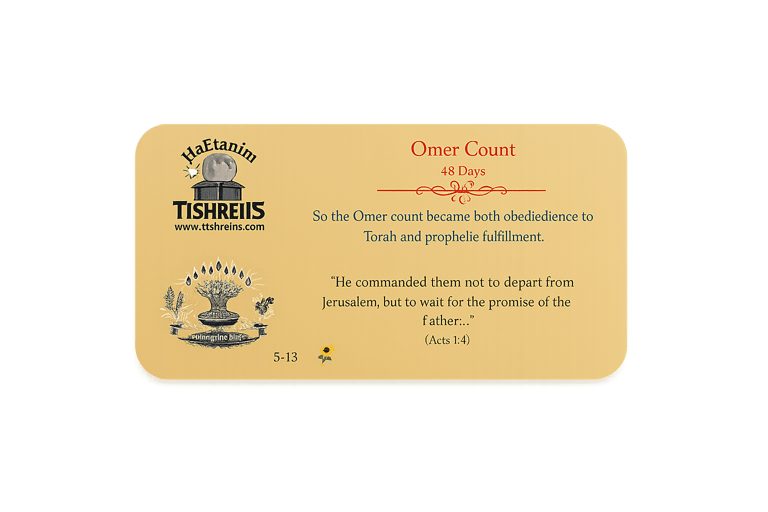
Counting the Omer
סְפִירַת הָעוֹמֶר
The Omer Count is the 49‑day ascent from the barley sheaf
of Firstfruits to the two wheat loaves of Shavuot - the
harvest‑ladder between redemption and revelation. This is
the season when the grain for those loaves is gathered, soon
to be lifted together, long read as the joined offering of Jew
and Gentile before God: not one replacing another, but two
witnesses raised as one presentation, and it gives a whole
new meaning to “whole wheat.”
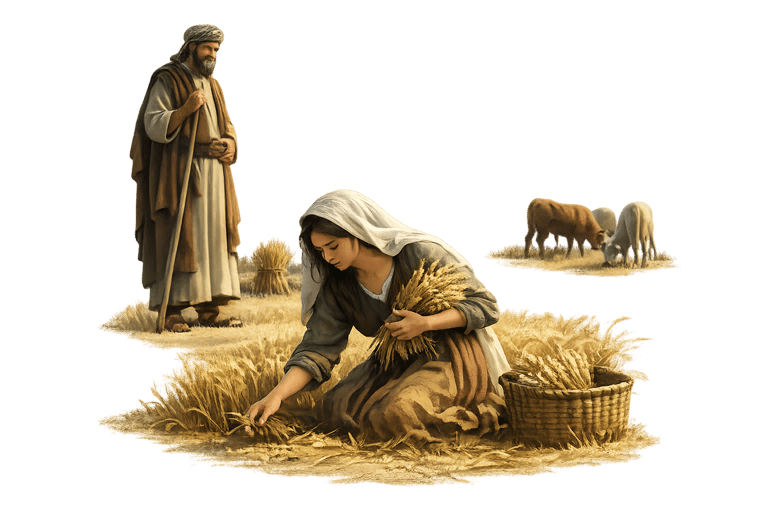
But the calendar is not finished speaking, because Ruth and Boaz live inside this very ascent.
Ruth steps into the field as the Torah’s own mercy‑architecture in motion, the outsider gleaning in the margins where God hides His provision. And what can be gleaned from her gleaning? That faith walks behind the reapers, that covenant grace waits in the corners of the field, that the Moabite woman becomes the living parable of the nations gathered into Israel’s harvest. Her hands gather grain, but heaven is gathering her.
Boaz, for his part, stands as the righteous landowner who keeps the Torah not by minimum compliance but by overflowing generosity. He becomes the embodiment of the Redeemer who notices the outsider, covers her with his wings, and brings her into the lineage of kings. His field becomes the hinge between barley and wheat, between the law’s command and the law’s fulfillment.
Their lives are the Omer in flesh; barley beginnings, wheat completion, mercy in the margins, redemption in the open field.
And what does the Torah lift at the end of this ascent? Two loaves. Not one replacing the other, not one absorbing the other, but two witnesses raised as one presentation before God, the joined offering of Israel and the nations.
Ruth and Boaz are the prototype of that offering. She is the Gentile loaf, gathered from the edges. He is the Israelite loaf, rooted in covenant soil. And in their union, the harvest becomes prophecy: the nations gleaning in Israel’s field, and Israel’s Redeemer receiving the nations.
Their marriage is the Shavuot symbol before Shavuot had symbols. Their son becomes the ancestor of David, and David becomes the ancestor of Messiah, the One in whom the two loaves finally rise in fullness.
And still the calendar rises.
Shemini Atzeret is the calendar’s own witness, the moed that refuses coincidence, the built‑in context that interprets itself. For when the Child who tabernacled among us enters the world on the first day of Sukkot, the day of the fragile booth, the day of temporary dwelling, the day Israel remembers that God once lived with them in a tent, the pattern is already set (John 1:14; Leviticus 23:34–43).
And eight days later, because the Torah binds the covenant to the eighth day without negotiation (Genesis 17:12; Leviticus 12:3), when the sukkot are taken down and Israel stands bare before the Presence on the Eighth Day of Assembly (Leviticus 23:36; Numbers 29:35), He receives the covenant in His own flesh (Luke 2:21). The booth collapses; the veil of flesh is marked; the Name is placed upon Him.
The temporary dwelling and the eternal covenant meet in a single week. Sukkot gives Him His tent — the incarnate sukkah, the body prepared for Him (Hebrews 10:5). Shemini Atzeret gives Him His Name; the covenant seal, the eighth‑day identity, the moment of belonging and nearness.
This is not accident. This is the moed bowing to the Messiah it foretold, the calendar bending toward the One it was built to reveal, the seven days of dwelling yielding to the Eighth Day of remaining, the seventy bulls of the nations collapsing into the one bull of covenant intimacy, the temporary tent giving way to the eternal Dweller.
And Ruth and Boaz, standing in the fields between barley and wheat, become the quiet prophecy of that same ingathering: the nations gleaning in Israel’s field, the Redeemer extending His wing, the harvest becoming the parable.


Faith
Nature
contact@tishrei15.com
© 2025. All rights reserved.