Announcing that the great day of the lord is nearer than you think. O Come let us adore him - Luke 2:13
Ring H
4-13
Unleavened Bread
מַצָּה
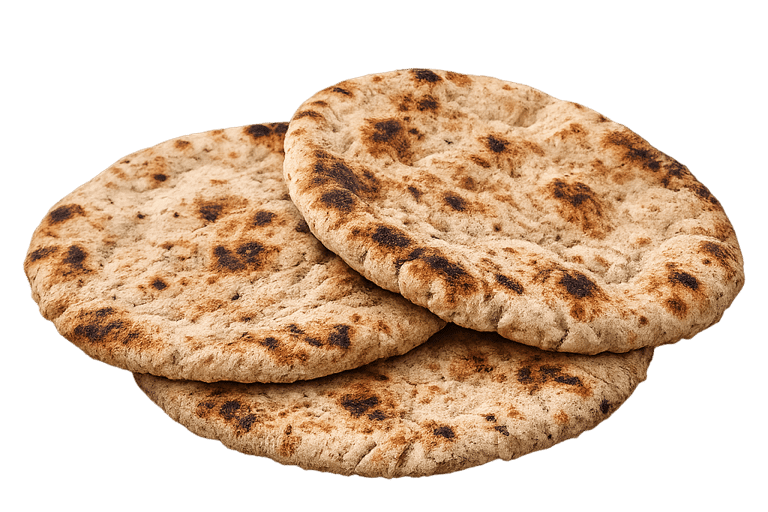
There is a rhythm older than Israel and yet entrusted to her, a rhythm that begins with a house swept clean and a people stepping out of the world that enslaved them. Unleavened Bread is that rhythm. Scripture frames it with precision: seven days without leaven, no mixture, no residue of the old life (Ex 12:15–20); a festival held between two convocations, holiness guarding both gates (Lev 23:6–8); the “bread of affliction,” yet also the bread of haste, the taste of a world collapsing behind you (Deut 16:3).
The calendar itself becomes a corridor. It opens on 15 Nisan, runs its seven‑day course, and closes on 21 Nisan. Between those days Israel walks a liminal passage, Egypt behind, Sinai ahead; the sea sealing the past, the mountain summoning the future. It is not merely time passing; it is creation being reset.
For Unleavened Bread is the moed, the appointed time, the God‑set moment, where creation language is rebuilt. No leaven: no old fermentation, no inherited decay. Seven days: the full creation cycle, restarted. Bread without rise: a humanity without the swelling of corruption. Haste: the new creation refusing to wait for the old to finish dying.
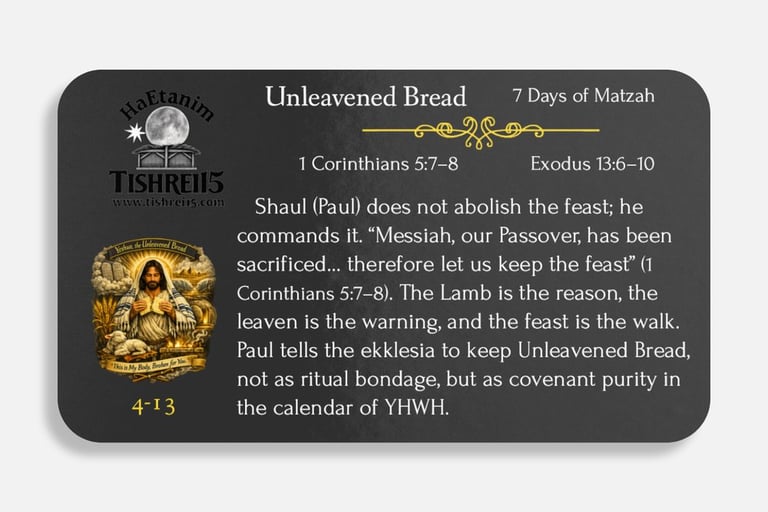
This is why Shaul speaks the way he does. He does not abolish the feast; he commands it. “Messiah, our Passover, has been sacrificed… therefore let us keep the feast” (1 Cor 5:7–8). The Feast is not moralism; it is ontology, the nature of being itself, what kind of creation you now are.
And into this architecture steps Yeshua the Messiah, not as an observer of the pattern but as its living fulfillment. He becomes the Unleavened Bread, sinless, broken, given, and resting in the earth during the very days Moshe commanded Israel to cast out corruption (Ex 12:15–20; Lev 23:6–8). His role is not symbolic; it is structural. His function is not illustrative; it is constitutive. When He takes the bread and says, “This is My body” (Matt 26:26; Luke 22:19), He is stepping into the feast as its center, its meaning, its telos. The feast is the pattern; He is the substance. To keep Unleavened Bread is to walk in the purity He embodied and the calendar His Father ordained.
Even the korbanot, the offerings that draw near, the gifts that bring the worshiper close, do not stand beside His story; they run through it like arteries. The seven‑day sacrificial rhythm becomes a living frame around His death, His burial, and His rising. Moshe’s liturgy wraps itself around the work of the Lamb because the Lamb Himself is the One who gave the liturgy its shape.
The bulls of renewal (Num 28:19–20) answer the covenant He restores (Luke 22:20; Jer 31:31–33). The ram of obedience (Num 28:19; Gen 22) mirrors the Son who obeys unto death (Phil 2:8). The lambs of innocence, seven each day (Num 28:19, 24), declare the perfection of the Lamb without blemish (Ex 12:5; 1 Pet 1:19). The goat of atonement (Num 28:22, 24) points to the One who bears the iniquity of the people (Isa 53:6; Heb 9:28). The grain of purity, fine flour and oil (Num 28:20–21), echoes the One upon whom the Spirit rests without measure (Isa 11:2; John 3:34). The wine poured beside the altar (Num 28:24) answers His own words, “This is My blood of the covenant” (Matt 26:28). And the seven days of incorruption (Lev 23:6–8) find their fulfillment in the body that did not see decay (Ps 16:10; Acts 2:31).
Thus the feast stands: the pattern and the substance, the liturgy and the Lamb, the calendar and the new creation. Unleavened Bread is not merely remembered; it is inhabited, first by Him, then by all who walk in His unleavened life.
Unleavened Bread may look stale, flat, or past its due date, but its whole message is about the future, because the only thing that’s actually expired is the old creation. This is the place where the past reaches forward, placing its hand on the present, reminding us that what looks ancient is in fact the doorway into what comes next. And if a blind man were to handle matzah, he might run his fingers across its surface and ask, “Who wrote this?”, which is ironically the same question the modern Christian asks. The answer is the same for both: God wrote it long ago, and He wrote it for us.


Faith
Nature
contact@tishrei15.com
© 2025. All rights reserved.